
Free Education · Evidence-Led
Oil Truth: What Crude Oil Is and Why It Still Matters
A plain-English, evidence-led primer for people who want to understand the commodity before they follow the market. No politics — just how the system actually works.
What crude oil is
Crude oil is a naturally occurring mixture of hydrocarbons formed from ancient organic matter under heat and pressure over geological time. Different fields produce different grades — lighter or heavier, sweeter (less sulphur) or more sour — and refineries are tuned to particular diets of these grades. “Oil” is not one product but a family of raw materials.
What oil and gas are actually used for
A barrel of crude is separated in a refinery into fractions, each with its own market:
- Transport: petrol, diesel, jet fuel and marine fuel — moving people, food and freight.
- Petrochemicals: the feedstock for plastics, packaging, synthetic fibres, paints and adhesives.
- Medicine: pharmaceutical precursors, sterile plastics, syringes, tubing and equipment.
- Fertilisers: natural gas is the key input to ammonia production, which underpins roughly half of global food production.
- Construction: bitumen for roads and roofing; energy for cement and steel.
- Aviation and shipping: sectors with few near-term energy-dense substitutes.
This is why oil is not just petrol: even in a world of rapidly electrifying road transport, the non-fuel and hard-to-substitute uses of hydrocarbons persist.
How oil prices affect inflation
Energy is embedded in the cost of nearly everything. Diesel moves food from field to shelf; gas makes the fertiliser that grew it; petrochemicals wrap it. When crude rises, these costs flow through supply chains with a lag, showing up first in fuel and energy bills and later in core goods. This transmission is why energy shocks are macroeconomic events, not just sector news.
Why energy density matters
Hydrocarbons pack a large amount of energy into a small mass and volume, are storable for years, and are transportable in ordinary steel. That combination — density, storability, transportability — is what alternatives must match or work around, and it explains why aviation, shipping and heavy industry are the slowest sectors to substitute.
Why domestic production matters
A barrel not produced at home is a barrel imported — with the jobs, tax revenue and supply-chain capability located elsewhere, and with supply security dependent on shipping lanes and other governments' choices. Domestic production is not a substitute for reducing demand; it determines who supplies whatever demand exists.
Reducing production is not the same as reducing demand
Demand is set by what consumers and industry actually use. If production falls in one country while demand is unchanged, imports rise to fill the gap. The emissions, economic activity and geopolitical leverage associated with that supply shift location — they do not disappear. Serious energy policy, and serious energy investing, treats demand and supply as separate questions.
Why oil and gas remain central to global energy systems
Hydrocarbons still supply the majority of the world's primary energy (see the Energy Institute Statistical Review for current figures). Transitions are underway and investable — but they are additive and gradual at global scale, constrained by capital cycles, materials and infrastructure. For investors, the truth is neither “oil is over” nor “nothing changes”: it is a long, uneven rebalancing in which both hydrocarbon and transition assets will make and lose fortunes. Understanding the physical system is the edge.
How much is left? Reserves and depletion horizons
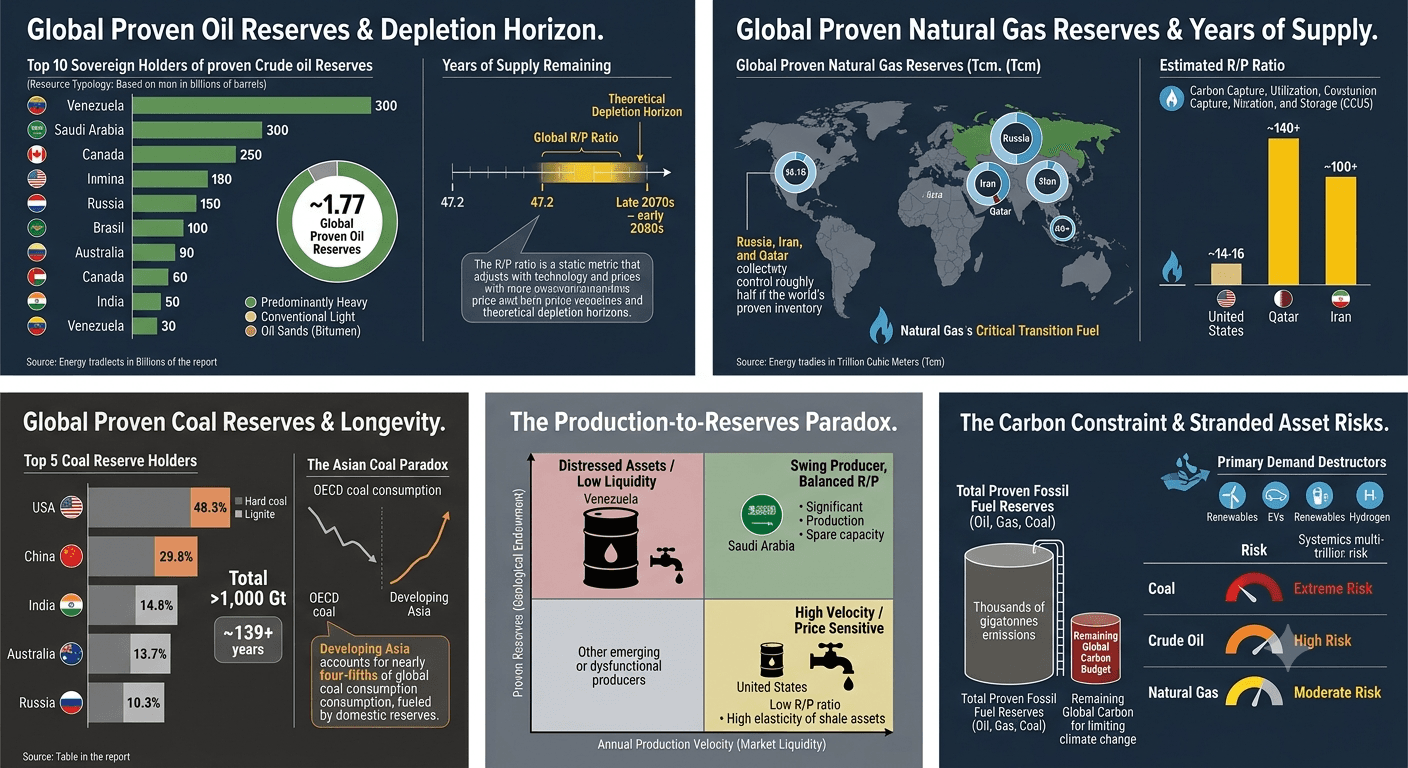
One of the most common questions novices ask is “when does the oil run out?” The professional answer is that reserves are an economic number, not just a geological one: they grow with technology and price, and the reserves-to-production (R/P) ratio is a snapshot, not a countdown. Our report Energy Reserves and Years Remaining works through oil, gas and coal reserve concentration, R/P ratios and what they do — and don't — tell investors.
Sources for the numbers
Frequently asked questions
Is oil only used for petrol and diesel?
No. Road fuels are the largest single use, but a barrel of crude also yields jet fuel, marine fuel, petrochemical feedstocks (plastics, synthetic fibres, pharmaceuticals precursors), lubricants, bitumen for roads, and more. Natural gas additionally underpins fertiliser production via ammonia.
If a country produces less oil, does the world use less oil?
Not necessarily. Demand is set by consumers, not by any single producer. If one region cuts production while demand is unchanged, supply generally shifts to other producers — often with longer shipping distances and different regulatory standards.
Why do oil prices show up in inflation?
Energy is an input to almost everything: transport, food production (diesel and fertiliser), manufacturing and heating. When crude and gas prices rise, those costs propagate through supply chains into consumer prices — which is why central banks watch energy closely.
Now 100% Free
Everything on The Crude Oracle is free
The paywall has been removed. The full dashboard, daily briefings, investment watchlist, company intelligence and every analysis tool are open to everyone — no card, no account required.
Not financial advice — capital at risk. All data labelled with source and freshness.